


 Manufacturer-conducted evaluation
Thermal performance + static-load data
Heat management.
Measured performance.
We built the DualCool handguard to address heat at the gripping surface without treating structural rigidity as an afterthought. Here are the results of our controlled thermal comparison and separate static-load evaluations of standard DualCool and DualCool ARCA15.
Thermal test: July 11, 2026 · Main Line Armory, Malvern, Pennsylvania · 70°F indoors
Controlled indoor thermal testing
The purpose was straightforward: compare external handguard temperatures while keeping the rifle and firing conditions consistent. We conducted the test indoors at Main Line Armory to remove outdoor weather changes as a variable.
Both handguard configurations were tested on the same 16-inch cold-hammer-forged Mitchell Defense DOC 5.56 rifle . We changed only the handguard between configurations and allowed the rifle to cool completely before beginning the next configuration. This reduced the rifle-to-rifle differences that can complicate a thermal comparison.
| Date and location | July 11, 2026; Main Line Armory, Malvern, Pennsylvania. |
|---|---|
| Environment | 70°F indoors. Range ventilation was not separately quantified. |
| Test platform | 16-inch CHF DOC 5.56; mid-length gas system; no suppressor. |
| Handguard samples | Standard DualCool and one traditional comparison handguard. The comparison sample’s manufacturer and model were not recorded in the source workbook. |
| Ammunition | 55-grain 5.56; same brand and type throughout. Test notes identify Winchester, although the brand was not independently verified. |
| Firing cadence | Semi-automatic at a reported steady cadence of approximately two rounds per second. |
| Support and camera | Two Vets tripod with ARCA mount; FLIR E54 thermal camera. |
| Measured surfaces | External handguard zones near the barrel nut, mid-handguard, and gas block; not the barrel or gas block itself. |
Four firing courses. One progressive sequence.
Each configuration completed 30, 60, 90, and 120-round courses, for 300 rounds per configuration. Readings were recorded at 30, 60, 90, and 120 seconds after firing, followed by a final reading at seven minutes. The next course began immediately after that seven-minute recovery period.
The rifle was not returned to ambient temperature between courses. The sequence intentionally retained accumulated heat. Full cooldown occurred between handguard configurations, not between each round-count stage.
Source: Mitchell Defense technical report v1.3, Sections 3–4, and the original thermal workbook. Source notes.
Lower temperatures at every matched point
Four courses, three locations, and five post-fire times produced 60 matched temperature pairs. DualCool measured lower than the traditional comparison handguard in every pair.
Across the complete dataset, the traditional handguard averaged 134.9°F and DualCool averaged 110.7°F—a 24.2°F lower average measured surface temperature. Relative to the 70°F indoor baseline, that is a 37.2% reduction in average temperature rise.
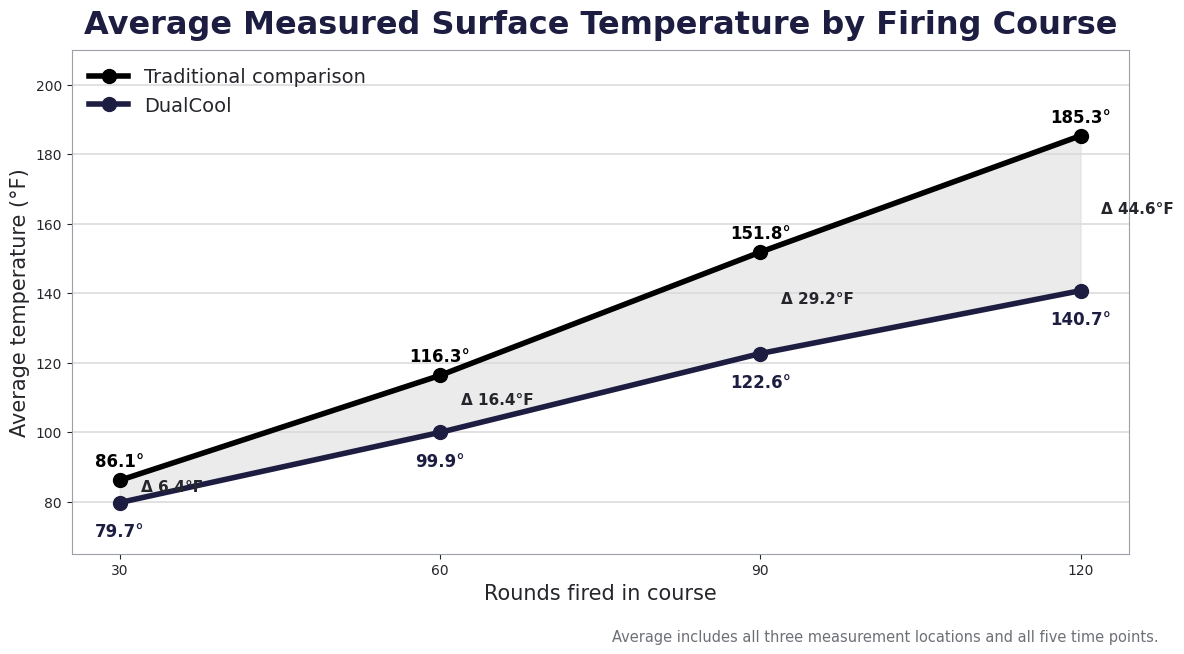
| Course | Traditional | DualCool | Lower readings |
|---|---|---|---|
| 30 rounds | 86.1°F | 79.7°F | 15 / 15 |
| 60 rounds | 116.3°F | 99.9°F | 15 / 15 |
| 90 rounds | 151.8°F | 122.6°F | 15 / 15 |
| 120 rounds | 185.3°F | 140.7°F | 15 / 15 |
The largest separation occurred in the high-heat course
During the 120-round course, DualCool averaged 44.6°F lower across all 15 matched points. Looking only at the 30–120-second post-fire readings, the average difference was 47.2°F. At seven minutes, DualCool still averaged 34.3°F lower across the three locations.
The largest matched difference was 52°F. One example was the external gas-block-area reading at 120 seconds: 205°F for the traditional handguard versus 153°F for DualCool .
In this progressive sequence, the average separation grew from 6.4°F in the 30-round course to 44.6°F in the 120-round course. The measured advantage became more pronounced as the sequence accumulated heat.
View all 60 matched thermal readings
All temperatures are in °F. T = traditional comparison handguard; DC = DualCool. Times are elapsed after the final shot of each course. On a narrow screen, scroll the table horizontally.
| Rounds | After firing | Barrel-nut area | Mid-handguard | Gas-block area | |||
|---|---|---|---|---|---|---|---|
| T | DC | T | DC | T | DC | ||
| 30 | 30 sec | 81 | 77 | 81 | 77 | 79 | 75 |
| 30 | 60 sec | 86 | 79 | 84 | 79 | 82 | 77 |
| 30 | 90 sec | 90 | 81 | 88 | 79 | 86 | 79 |
| 30 | 120 sec | 91 | 82 | 88 | 82 | 88 | 81 |
| 30 | 7 min | 90 | 82 | 88 | 84 | 90 | 82 |
| 60 | 30 sec | 109 | 93 | 109 | 97 | 111 | 95 |
| 60 | 75 sec* | 118 | 100 | 115 | 100 | 118 | 102 |
| 60 | 90 sec | 120 | 100 | 117 | 102 | 120 | 102 |
| 60 | 120 sec | 122 | 102 | 118 | 104 | 122 | 104 |
| 60 | 7 min | 115 | 99 | 113 | 99 | 118 | 99 |
| 90 | 30 sec | 142 | 111 | 151 | 120 | 153 | 127 |
| 90 | 60 sec | 149 | 115 | 154 | 124 | 158 | 131 |
| 90 | 90 sec | 153 | 118 | 156 | 126 | 162 | 135 |
| 90 | 120 sec | 156 | 120 | 158 | 126 | 163 | 136 |
| 90 | 7 min | 138 | 111 | 140 | 115 | 144 | 124 |
| 120 | 30 sec | 169 | 124 | 189 | 149 | 192 | 140 |
| 120 | 60 sec | 180 | 129 | 194 | 154 | 199 | 149 |
| 120 | 90 sec | 185 | 133 | 194 | 154 | 203 | 151 |
| 120 | 120 sec | 187 | 135 | 194 | 154 | 205 | 153 |
| 120 | 7 min | 160 | 122 | 162 | 133 | 167 | 131 |
*The original 60-second label in the 60-round course is corrected to 75 seconds for both handguards. Starting temperatures were recorded as 70°F for both configurations.
Source: original dual cool handguard test.xlsx; technical report v1.3, Section 5 and Appendix A. Source notes.
An air-gapped structure around the contact surface
DualCool is additively manufactured from CP1 alloy. Its air-gapped thermal-barrier architecture is designed to reduce heat migration into the hand-contact areas. The standard handguard also incorporates grip texture formed directly in the metal.

The thermal evaluation measured the resulting exterior temperatures. It did not separately measure the contribution of each design feature or establish that the barrel itself ran cooler.
Design reference: DualCool CP1 handguard specifications .
Standard DualCool versus DualCool ARCA15
Separate static-load evaluations recorded the response of the 15-inch standard DualCool and 15-inch DualCool ARCA15. At our Glenside, Pennsylvania shop, the upper receiver was secured in a vise and weights were applied to the bottom of the rail to represent loading associated with a bipod or barricade.
The documented setup placed the load at the 11-inch/T40 position, with a laser at the forward end of the handguard. We measured the laser spot’s movement on a wall 21 feet away as applied load increased from 5.8 to 25.4 lb. The recorded indoor temperature was 72°F.
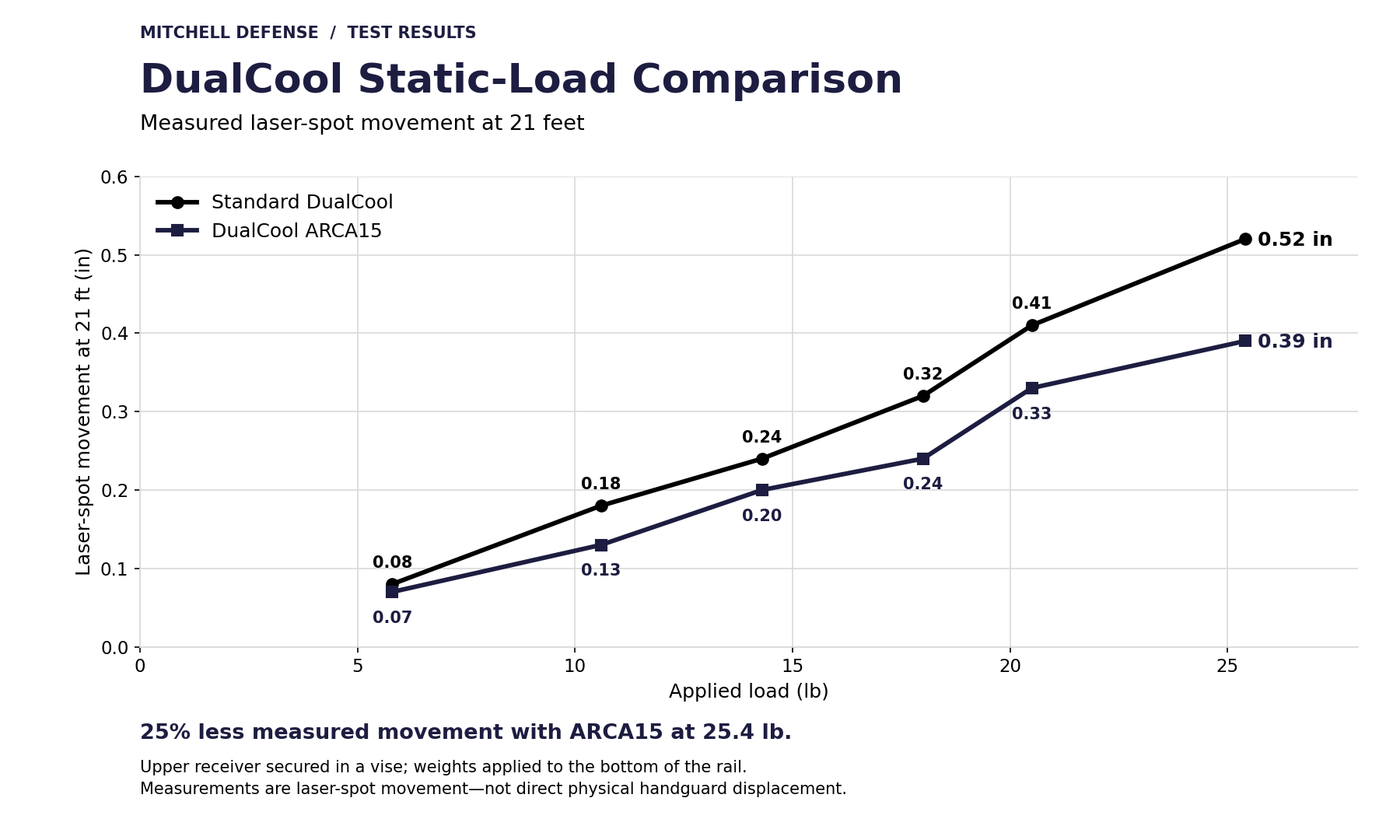
| Applied load | Standard DualCool | DualCool ARCA15 | ARCA15 reduction |
|---|---|---|---|
| 5.8 lb | 0.08 in | 0.07 in | 12.5% |
| 10.6 lb | 0.18 in | 0.13 in | 27.8% |
| 14.3 lb | 0.24 in | 0.20 in | 16.7% |
| 18.0 lb | 0.32 in | 0.24 in | 25.0% |
| 20.5 lb | 0.41 in | 0.33 in | 19.5% |
| 25.4 lb | 0.52 in | 0.39 in | 25.0% |
Putting the wall movement into angular context
Using the 252-inch target distance, the maximum-load results correspond to apparent angular equivalents of 7.09 MOA for standard DualCool and 5.32 MOA for ARCA15. These are geometric conversions of measured wall-spot movement, not measured bullet-impact shifts.
The setup did not isolate fixture, receiver, or laser-mount movement. Unloaded return-to-zero and permanent deformation were not recorded, so those properties cannot be inferred from these load measurements.
Source: manufacturer-supplied static-load datasets; technical report v1.3, Sections 6.1–6.2. Source notes.
Context from publicly available rail testing
Mitchell Graf’s GunsAmerica rail evaluation used 25.04 lb at T40, a receiver-referenced laser measurement at 25 yards, and four measurements per configuration. The following ten results are the subset retained in our report.
| Published configuration | Reported shift (MOA) |
|---|---|
| Aero Precision MOD 4 | 7.86 |
| Ripcord Industries LDR1 | 7.92 |
| Aero Enhanced Gen 2 / M4E1 Enhanced upper* | 7.96 |
| Seekins SP3R V3 / conventional upper | 8.58 |
| Geissele MK16 | 8.88 |
| Midwest Industries Nightfighter | 9.48 |
| BCM MCMR | 11.46 |
| Daniel Defense RIS III | 11.76 |
| Aero ATLAS R-ONE | 11.96 |
| Seekins NOXS | 14.60 |
Scope: excludes the Seekins SP3R V3/iRMT-3 and LMT MRP-L Quad configurations because of their different upper/rail construction. *The retained Aero M4E1 configuration also uses a proprietary mount; it is not construction-equivalent.
Watch the thermal test
The video provides a visual record of the evaluation. The recorded workbook and documented timing correction remain the numerical source of record for the results above.
What these tests establish
The thermal result is consistent across the measured dataset: DualCool’s external surface was cooler at every matched location and time . The largest average separation occurred in the highest-round-count course. In the separate static-load evaluations, ARCA15 recorded less laser-spot movement than standard DualCool at every tested load.
These are manufacturer-conducted engineering observations from the documented test articles, not independent certification or a guarantee for every handguard length and firearm configuration. The 60 thermal pairs are observations within one progressive sequence per configuration—not 60 independently repeated trials. The ARCA15 static-load result is not a separate ARCA15 thermal test.
Measurement limits and safe interpretation
Temperature measurement: camera emissivity and reflected-temperature settings, exact camera distance and angle, and measurement-point marking were not documented. The comparison handguard’s mass and finish were also not recorded. The reported values are camera readings, not a calibrated touch-safety certification.
Cooler does not mean safe to hold indefinitely. No bare-hand or glove-specific safe holding time was established. The test does not identify a universal temperature at which gloves stop protecting the hand.
Scope: the thermal evaluation used one rifle and one progressive sequence per configuration. It does not establish performance for other ammunition, suppressors, environments, or every production unit. Static-load results describe movement while loaded, not impact durability or return-to-zero after unloading.
Traceable data. Documented methods.
Mitchell Defense data: DualCool Handguard: Comparative Thermal Performance and Static Load / Laser Shift Evaluation , technical report v1.3; original dual cool handguard test.xlsx; manufacturer-supplied standard DualCool and ARCA15 static-load readings; and test-owner clarifications, including the July 11, 2026 date and matched 75-second timing correction. Course averages equally weight each sampled location and time; calculations use unrounded readings.
External comparison: Mitchell Graf, GunsAmerica, “Rigidity Matters”, Table 1. External results are identified separately above.
DualCool CP1 and ARCA Rail Edition
Review the handguard specifications, available configurations, and mounting features on the product pages.

